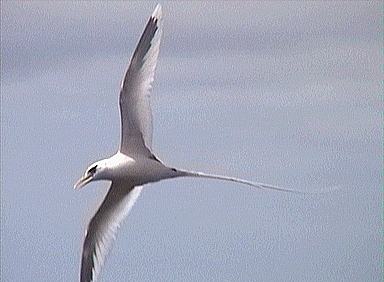
Do you still
need Red-tailed AND White-tailed Tropicbirds for your list or how about Greater AND Lesser
Frigatebirds? Is Red-footed Booby a 'bogie bird' for you? Have
you been dipping out on Audubon's Shearwater? If so, then come and
join us on a mega-pelagic into the Mozambique Channel in late November
2005 where we will be visiting a series of under-seamounts and these
birds' breeding island - Europa Island.
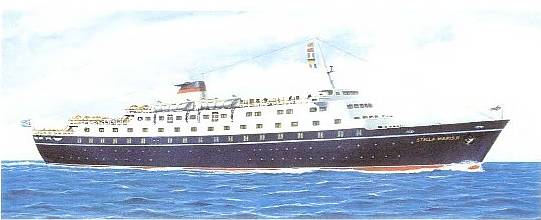
Two of these seamounts (Almirante Leite and Hall Tablemount) are within Southern African birding waters and we aim to visit them to observe the bird life that is attracted to these areas. From the Hall Seamount, it is a half-days cruising via the Jaguar Seamount to the vicinity of Europa Island.
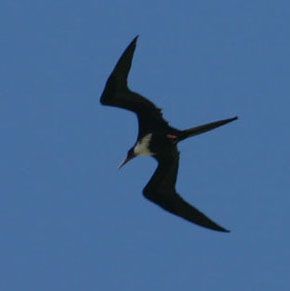
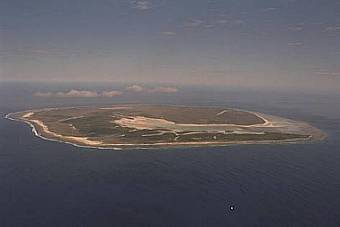
Greater Frigatebird - 700 to 1100 pairs
Lesser Frigatebird - 1000 to 1200 pairs
Sooty Tern - 500000 to 1000000 pairs
White-tailed Tropicbird - 500 to 1000 pairs
Red-tailed Tropicbird - 3000 to 4000 pairs
Red-footed Booby - 2800 to 3800 pairs
Audubon's (Tropical) Shearwater - 50 to 100 pairs
Interestingly, the Audubon's Shearwaters
on Europa Island are thought to be of the subspecies bailloni which
show mostly white undertail coverts and not brown as in all other
subspecies. In our time around the island, we probably also have the best
chance of seeing the rare and restricted golden morph of the White-tailed
Tropicbird.
If we can get close enough to the island, we may be able to see some of
the resident Dimorphic Egrets and Madagascar Pond Herons.
Other special birds to watch for are migrating Black-bellied Storm Petrels, Black-naped and White-cheeked Terns and maybe even White-headed Petrel, Jouanin's Petrel, White-faced Storm Petrel or even a Barau's Petrel which have all been recorded in southern African waters in the areas we will be visiting!!! And then of course, there is the possibility of recording new species for the Southern African list and vague possibilities include Masked Booby, White Tern, Swinhoe's Storm Petrel, Round Island Petrel and maybe even Mascarene Petrel!! All in all, it should make for an exciting trip that you wouldn't want to miss!!
The costs for the trip are based on the various types of cabins and will be as follows:
In order to make a booking, please email us
at bookings@zestforbirds.co.za
to reserve your places.
We really do hope that you will be able to join us on this trip as, not only will
there be some absolutely awesome birding with hopefully many brilliant
birds being added to all of your lists, it should be one of the best
birding social events in South African birding history!! Just imagine sharing all of these mega
lifers with so many other birding friends...